

THE INSTITUTE
Building the Future of
Human Capacity
NeuroVeda advances the science and practice of human capacity — drawing on neuroscience, organizational science, and human development. We strengthen the conditions that help people and organizations grow and adapt.
WHY THE INSTITUTE EXISTS
Lasting Change Takes Time
Organizations are often expected to transform quickly — new strategies, restructures, and initiatives, all launched hoping meaningful change will follow.
Yet real development rarely follows a project timeline. Capacity grows through repeated experience, trusted relationships, reflective leadership, and systems that keep strengthening long after any single intervention ends.
NeuroVeda was built for that reality — strengthening the conditions that let people, teams, and organizations keep developing long after an engagement ends.
ORGANIZATIONS ARE LIVING SYSTEMS
Beneath Every Healthy Forest Is an Invisible Network
A forest’s strength isn’t in its individual trees. Beneath the surface, mycelial networks connect roots, share resources, and keep the whole ecosystem healthy.
Organizations function in much the same way.
Leadership shapes culture, culture shapes relationships, and relationships shape trust, learning, and adaptation. The most important dynamics are often the ones you can’t see.
We approach organizations as living systems, where lasting change comes from strengthening the health of the whole rather than optimizing isolated parts.

BUILDING CAPACITY ACROSS GENERATIONS
Strengthening Organizations for the Future
Most initiatives solve today’s problems. The Institute asks a longer question:
How do we strengthen organizations so they continue to grow decades from now?
Long-term capacity prepares organizations not just for today’s complexity, but to keep learning, evolving, and contributing well into the future.
THE INSTITUTE
One Institution. Three Integrated Functions.
Complex challenges rarely have a single cause — or a single-discipline fix.
Organizations are shaped by biology, relationships, leadership, culture, history, and environment — more than technical expertise alone can explain.
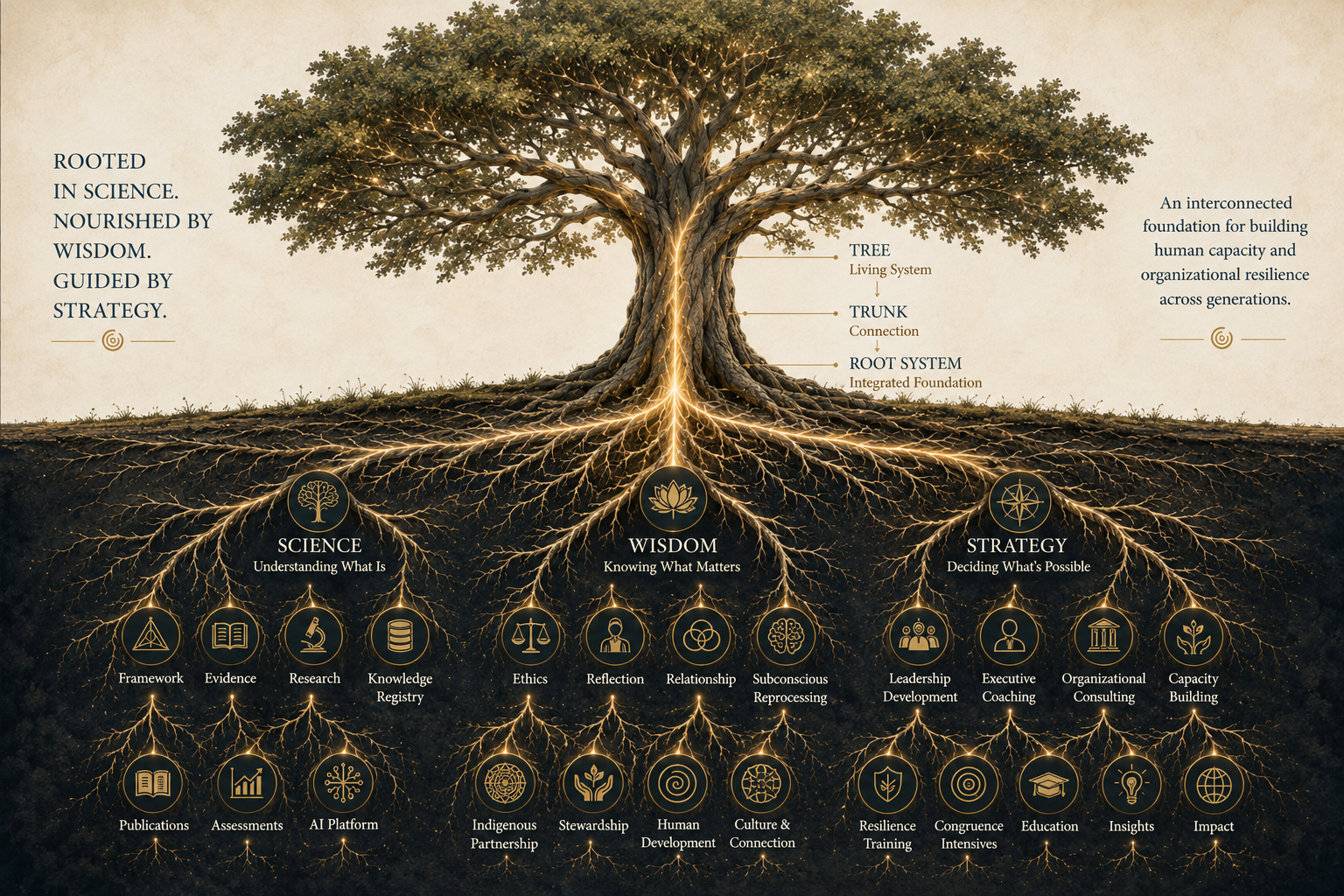
Science
Evidence, disciplined inquiry, and evolving knowledge.
Wisdom
Judgment, relationship, lived experience, and ethical context.
Strategy
Practical action, organizational development, and enduring capacity.
NeuroVeda brings together three complementary perspectives that inform every aspect of the Institute’s work.
HOW EVERYTHING CONNECTS
The Architecture Beneath the Institute
Just as the visible strength of a tree depends upon the health of its roots, every aspect of NeuroVeda grows from the same institutional foundation.
SCIENTIFIC FOUNDATIONS
Grounded in Four Foundational Pillars
Our work rests on four foundational pillars — Human Neuroscience, Organizational Science, Human Development, and Indigenous Partnership — converging to support human capacity as an emergent property.
The greatest measure of capacity building is not what changes today, but what continues to grow long after the work is complete.
STEWARDSHIP
Building for Sustainability
NeuroVeda is designed as a long-term institution.
Meaningful progress depends as much on responsible stewardship as on innovation.
Five stewardship commitments guide the Institute:
Evidence
Partnership
Stewardship
Capacity
Continuous Learning
MEET THE FOUNDER
Natalie Koleric
Founder, NeuroVeda Institute

I have spent my career inside the systems meant to help people — child welfare, youth treatment, community mental health. And I kept watching the same thing happen: capable, committed people, genuinely good at their work, worn down or harmed by the systems around them. Not because they lacked skill or care, but because the systems themselves were built in ways that quietly ground people down.
I trained as a systemic therapist — a discipline founded on a single idea: a person can rarely be understood apart from the systems they live and work within. When someone is struggling, the cause usually isn’t the person themselves; it is either a pattern in the system they are in, or a reflection of how their own internal system is operating. I have spent years applying that lens with families and individuals. NeuroVeda is where I bring it to organizations.
As a therapist, I work from a second-order change perspective: I look past the presenting problem to its actual source — whether that lies in a person’s relationship to the parts of themselves, to another person, or to the context they are in. I immensely enjoy that work with individuals, couples, families and groups. But I can’t shake the feeling that I am treating a symptom in our society when what I really want is to reach its cause. You cannot coach or train your way out of a system built to burn people out — you have to change how the system itself works.
That is what NeuroVeda exists to do: to understand how organizations actually function beneath the surface, and to help them become places where good people can do good work and stay well doing it. Healthier systems make for healthier people. Healthier people make for a healthier society. That is the whole of the goal.
Natalie holds two master’s degrees — a Master of Marriage and Family Therapy, and an earlier master’s in the study of power and social structure — and practises as a systemic therapist in Winnipeg. Her background includes more than a decade in frontline human-services systems.
PERSPECTIVES
Learning in Public
NeuroVeda is committed to sharing knowledge as the Institute grows.
As the Platform and Knowledge Registry develop, Perspectives will become our public home for selected scientific perspectives, framework developments, and evidence summaries.
We publish for depth, not volume — thoughtful, evidence-informed perspectives for leaders, organizations, and communities.
LET’S EXPLORE WHAT’S POSSIBLE
Begin a Conversation with the Institute
Every engagement begins with understanding.
Before discussing services or recommendations, we take time to understand the organization, its people, and its context.
From there, we determine together the most appropriate path forward.